Showing posts with label geothermal heat pump. Show all posts
Showing posts with label geothermal heat pump. Show all posts
Tuesday, January 17, 2012
geothermal heat pump towards a greenery development
When we utilize the geothermal concept of
cooling and heating to our home,we actually building up a superb Eco-friendly green home building or remodeling.
Saturday, August 28, 2010
Is a Geothermal System Right For You?
The latest rage in the heating and air conditioning field are geothermal heat pumps. Whether you are building a new home or looking to replace an existing system, you might want to consider switching to this long-lasting and cost-efficient system.
Saturday, November 14, 2009
Why a Heat Pump May Be the Best Way to Cool Your Home
It is impossible to turn on the news or open up a paper or magazine these days without seeing something about global warming. Ironically, one of the causes for the rising temperature of the planet is the energy used by the very products and systems we so desperately need to deal with mercurial temperature extremes. One way to cope with both situations simultaneously is to look at installing a heat pump in one's home rather than a standard gas or electric furnace.
Tuesday, November 3, 2009
Geothermal Heat Pump-Why are Geothermal Heat Pumps Efficient
Geothermal heat pumps are used for space heating and cooling, and if so equipped, also to heat water. Their high efficiencies are gaining more and more popularity for both residential and commercial buildings. It's not hard to see why. Rather than obtain heat through the combustion of fossil fuels, geothermal heat pump use the natural existing heat from the earth's ground source.
Think of the temperature of the ground as that of a cave. Beneath the earth's surface, the temperature remains relatively constant. Simply put, a geothermal heat pump takes the heat stored in the earth and transfers it into your home or office. During the summer, it does the opposite by transferring the heat from your home or office back into the ground. In other words, the ground acts as a natural heat source in the winter and a heat sink during the summer months.
But how does this highly energy efficient geothermal heat pump do this? First, a series of pipes, called a 'loop,' are buried either vertically or horizontally deep in the group. A water or anti-freeze solution circulates through the surrounding soil absorbing the earth's heat, or in the summer, relinquishing heat.
During the winter, heat is removed from the fluid in the earth's connection, concentrated, and transferred into your home. The processed is reversed in the summer; heat is removed from your home, concentrated, and placed back into the ground. Voila! An energy efficient system that reduces greenhouse gas emissions, cuts your electric bill nearly in half, requires lower maintenance, and may even lower your hot water bill.
By Geothermalcredit
Monday, October 26, 2009
Geothermal Heat Pump-Residential Heating And Cooling With Geothermal Heat Pumps
The term geothermal literally means Earth/Ground (Geo) Heat (thermal). Geothermal, or ground source heat pumps, take advantage of the constant ground or groundwater temperatures. These heat pumps use geothermal energy to heat and/or cool your home.
A refrigerant loop with a compressor extracts heat from one side (the ground) and pumps it to the heating loop in your home. It is essentially the same process that happens in your refrigerator: heat is extracted via a compressor and refrigerant loop from the inside of your refrigerator/freezer and rejected into your house.
In the summer the geothermal heat pump reverses its cycle, if you have an air-conditioning system, and heat from the home is rejected into the ground or ground water.
What makes geothermal heat pumps such a good choice for residential heating and cooling is that they do not depend on outside air temperatures. These heat pumps will heat your home as efficiently on a windy, zero-degree winter day as on a 40-degree day. Provided of course, that your house is well insulated and tight.
Geothermal heat pumps are also a very efficient way for heating and cooling your home. They use 25-50% less energy than conventional heating and cooling systems (Source: US DOE).
Residential applications of geothermal energy systems use water-to-water or water-to-air heat pumps.
Water-to-Water Geothermal Heat Pumps
Water-to-water geothermal heat pumps are generally used for heating only. They replace the gas or oil furnace that you might currently have to heat your home and water with.
It is important to know that heat pumps work most effectively when the temperature difference between the heat source (ground) and heat sink (floor heat or radiators) is small.
Ground temperatures range anywhere from 50 to 75 degF, depending on where you live. This means that geothermal heat pumps are generally not suitable for standard hot water baseboard applications, which are designed for heating water temperatures of 180 degF. Floor heat and low-temperature radiators require water temperatures in the range of 95 to 140 degF.
Some newer heat pump models are now equipped with so-called desuperheaters that can transfer excess heat from the geothermal heat pump compressor to the domestic water heater. Your geothermal heat pump can also effectively and quickly heat water for your bathtub, shower and sinks.
Water-To-Air Geothermal Heat Pumps
These types of ground source heat pumps are generally used when you need air conditioning. The Water is the heat sink, where you reject the heat from the house. The Air is the air that is distributed through your home via duct work.
Otherwise, these heat pumps function the same way as water-to-water heat pumps. And again, the efficiency of a geothermal heating and cooling system is far better than that of a traditional system.
Important To Know
The first step towards making a geothermal heat pump system be a reliable and efficient heating (and cooling) system for your home is to minimize the heating and cooling requirements with a well-insulated building envelope and strategically placed windows for passive solar gain.
Not only is your first cost reduced, because your system will be smaller. You will also tremendously increase the comfort of your home.
Geothermal heat pump systems are best designed and installed by professionals. It is not recommended to DIY. These systems must meet specific requirements. Especially the piping laid out in the ground, or down to the ground water table, must be designed and installed correctly to ensure that your geothermal heat pump system works as intended.
By Christiane Perrin
Geothermal Heat Pump-You Decide - Weighing the Pros and Cons of Geothermal Energy
There has been an ongoing debate pertaining to the pros and cons of geothermal energy. Before we can begin to discuss the advantages and disadvantages, we need to have a clear understanding of what exactly geothermal energy is.
4,000 miles below the Earth's surface is incredibly hot. It is thought to be over 7,000 degrees Fahrenheit. While this temperature is extremely dangerous and must be avoided, if you were to drill about 3 or 4 miles below the Earth's surface, you can find a hot rock that is far less dangerous, and it is at only 300 to 400 Fahrenheit. This rock and heat can be used as a constant source of heat but would prove to be very expensive.
Now while drilling and using this hot rock can be extremely expensive, there are other alternatives. In some places, only a few hundred feet below the surface there are areas that have combined this hot rock and underground water to produce hot water streams. This is the most economic source of heat below the earth and can be used in a number of ways. The heat can be used to heat homes, businesses and even run large farms or provide energy for greenhouses.
The constant source of geothermal energy comes with a number of benefits and a number of concerns. These pros and cons mostly relate to environmental issues, overall cost and reliability.
In terms of environmental effects, the impact of geothermal energy has more benefits than disadvantages. Geothermal facilities do not emit any emissions and on the whole, these factories take up far less space than any gas plants that are used for the same process. This is because the facilities do not require any underground pipelines to distribute fuel. Essentially geothermal energy is a universal contributor to a cleaner, safer and healthier environment.
On top of the environmental benefits, geothermal plants are not only more efficient but are also very reliable. The system is much simpler all around and there are a lot less problems that can occur in maintaining the facility. There is also no waste disposal and transport of fuel required to run the factory and produce energy.
The main con when discussing geothermal energy is the overall cost. The start up cost for geothermal power plants is quite substantial and this is the main argument against the energy source. However the truth is that this initial cost is often compensated for rather quickly as operation costs are extremely low in comparison to other sources of energy. The costs of drilling and maintaining these plants are also decreasing steadily.
The technology used for geothermal energy is constantly improving and geothermal plants are becoming more readily available. There is no denying the technology involved and once we continue to lower the overall cost, there will be no limit to the benefits that we can take advantage of through the use of geothermal energy.
By Darren W.Chow
Geothermal Heat Pump-Geothermal Energy - Free Heat
What in the world is geothermal energy? Geothermal energy is energy that is collected by piercing the reservoirs of heat that are trapped and stored underground. If you happen to reside in the western part of the United States, Alaska or Hawaii, you are located in a perfect spot to take advantage ofgeothermal energy for heating and cooling your home. These areas are located on or near "hot spots" on the earth's surface. Heating and cooling systems can be installed in other areas of the country but they would require digging down to a greater depth.
Geothermal resources are the most abundant and longest lasting resources we have. Our earth is home to so much thermal nuclear energy that it should be able to provide power for all of civilization for almost eternity. That is a very long time. According to theGeothermal Resource Data, there are more usable geothermal energy resources under our feet then all of the oil, coal, gas, and mineable nuclear fuels combined. There is only one problem; the initial cost of installing a heating and cooling system is very, very expensive. Even though this system will probably pay for itself in about ten years, the average homeowner usually can not afford to tap into this goldmine of freeheat.
However, if you are one of the people who are able to take advantage of the abundant supply of heat that is free for the taking, you will have an opportunity to experience a new, more comfortable way of heating and cooling your home.
By James Smithers
Sunday, October 18, 2009
Residential Heating And Cooling With Geothermal Heat Pump
The term geothermal literally means Earth/Ground (Geo) Heat (thermal). Geothermal, or ground source heat pumps, take advantage of the constant ground or groundwater temperatures. These heat pumps use geothermal energy to heat and/or cool your home.
A refrigerant loop with a compressor extracts heat from one side (the ground) and pumps it to the heating loop in your home. It is essentially the same process that happens in your refrigerator: heat is extracted via a compressor and refrigerant loop from the inside of your refrigerator/freezer and rejected into your house.
In the summer the geothermal heat pump reverses its cycle, if you have an air-conditioning system, and heat from the home is rejected into the ground or ground water.
What makes geothermal heat pumps such a good choice for residential heating and cooling is that they do not depend on outside air temperatures. These heat pumps will heat your home as efficiently on a windy, zero-degree winter day as on a 40-degree day. Provided of course, that your house is well insulated and tight.
Geothermal heat pumps are also a very efficient way for heating and cooling your home. They use 25-50% less energy than conventional heating and cooling systems (Source: US DOE).
Residential applications of geothermal energy systems use water-to-water or water-to-air heat pumps.
Water-to-Water Geothermal Heat Pumps
Water-to-water geothermal heat pumps are generally used for heating only. They replace the gas or oil furnace that you might currently have to heat your home and water with.
It is important to know that heat pumps work most effectively when the temperature difference between the heat source (ground) and heat sink (floor heat or radiators) is small.
Ground temperatures range anywhere from 50 to 75 degF, depending on where you live. This means that geothermal heat pumps are generally not suitable for standard hot water baseboard applications, which are designed for heating water temperatures of 180 degF. Floor heat and low-temperature radiators require water temperatures in the range of 95 to 140 degF.
Some newer heat pump models are now equipped with so-called desuperheaters that can transfer excess heat from the geothermal heat pump compressor to the domestic water heater. Your geothermal heat pump can also effectively and quickly heat water for your bathtub, shower and sinks.
Water-To-Air Geothermal Heat Pumps
These types of ground source heat pumps are generally used when you need air conditioning. The Water is the heat sink, where you reject the heat from the house. The Air is the air that is distributed through your home via duct work.
Otherwise, these heat pumps function the same way as water-to-water heat pumps. And again, the efficiency of a geothermal heating and cooling system is far better than that of a traditional system.
Important To Know
The first step towards making a geothermal heat pump system be a reliable and efficient heating (and cooling) system for your home is to minimize the heating and cooling requirements with a well-insulated building envelope and strategically placed windows for passive solar gain.
Not only is your first cost reduced, because your system will be smaller. You will also tremendously increase the comfort of your home.
Geothermal heat pump systems are best designed and installed by professionals. It is not recommended to DIY. These systems must meet specific requirements. Especially the piping laid out in the ground, or down to the ground water table, must be designed and installed correctly to ensure that your geothermal heat pump system works as intended.
By Christiane Perrin
A refrigerant loop with a compressor extracts heat from one side (the ground) and pumps it to the heating loop in your home. It is essentially the same process that happens in your refrigerator: heat is extracted via a compressor and refrigerant loop from the inside of your refrigerator/freezer and rejected into your house.
In the summer the geothermal heat pump reverses its cycle, if you have an air-conditioning system, and heat from the home is rejected into the ground or ground water.
What makes geothermal heat pumps such a good choice for residential heating and cooling is that they do not depend on outside air temperatures. These heat pumps will heat your home as efficiently on a windy, zero-degree winter day as on a 40-degree day. Provided of course, that your house is well insulated and tight.
Geothermal heat pumps are also a very efficient way for heating and cooling your home. They use 25-50% less energy than conventional heating and cooling systems (Source: US DOE).
Residential applications of geothermal energy systems use water-to-water or water-to-air heat pumps.
Water-to-Water Geothermal Heat Pumps
Water-to-water geothermal heat pumps are generally used for heating only. They replace the gas or oil furnace that you might currently have to heat your home and water with.
It is important to know that heat pumps work most effectively when the temperature difference between the heat source (ground) and heat sink (floor heat or radiators) is small.
Ground temperatures range anywhere from 50 to 75 degF, depending on where you live. This means that geothermal heat pumps are generally not suitable for standard hot water baseboard applications, which are designed for heating water temperatures of 180 degF. Floor heat and low-temperature radiators require water temperatures in the range of 95 to 140 degF.
Some newer heat pump models are now equipped with so-called desuperheaters that can transfer excess heat from the geothermal heat pump compressor to the domestic water heater. Your geothermal heat pump can also effectively and quickly heat water for your bathtub, shower and sinks.
Water-To-Air Geothermal Heat Pumps
These types of ground source heat pumps are generally used when you need air conditioning. The Water is the heat sink, where you reject the heat from the house. The Air is the air that is distributed through your home via duct work.
Otherwise, these heat pumps function the same way as water-to-water heat pumps. And again, the efficiency of a geothermal heating and cooling system is far better than that of a traditional system.
Important To Know
The first step towards making a geothermal heat pump system be a reliable and efficient heating (and cooling) system for your home is to minimize the heating and cooling requirements with a well-insulated building envelope and strategically placed windows for passive solar gain.
Not only is your first cost reduced, because your system will be smaller. You will also tremendously increase the comfort of your home.
Geothermal heat pump systems are best designed and installed by professionals. It is not recommended to DIY. These systems must meet specific requirements. Especially the piping laid out in the ground, or down to the ground water table, must be designed and installed correctly to ensure that your geothermal heat pump system works as intended.
By Christiane Perrin
Geothermal Heat Pump-How Does Geothermal Heating Work?
What is Geothermal Heating?
Humans have been using geothermal power for heating purposes for centuries. This specific type of energy has been contained within the heat that lies in the core of the earth since the planet was formed. The heat comes from radioactive decay of minerals as well as from solar energy that is absorbed at the earth's surface. Humans have figured out how to harvest this energy and put it to use in the form of heating. Typically, the heat is harvested near tectonic plate boundaries. In these regions, the ground as well as groundwater display temperatures higher than the target output.
A typical application involves a ground source heat pump underneath or near a home, that extracts the earth's natural energy and transforms it into usable heating output.
What are the benefits?
The chief benefit of using this type of heating system is energy conservation. In times when "going green" is the order of the day, this benefit is not to be taken lightly. Geothermal heating systems use up to 25% to 50% less electricity than conventional heating or cooling systems. Basically, this means that a geothermal heat pump uses one unit of electricity to extract three units of heat from the earth.
This natural form of heating can also help improve humidity control by maintaining about 50% relative indoor humidity, making geothermal heat pumps very helpful in humid climates.
Because these systems have no outdoor condensing units, like air conditioners have, you don't have to worry about a noisy apparatus outside your home.
How Does it Work?
To understand how this type of heating system works, it's important to understand its parts. A regular heat pump has an outdoor unit called condenser and an indoor unit that's called an evaporator coil. A material called a refrigerant transports the heat from one area to another. When compressed, it is a high temperature, high-pressure liquid. If it is allowed to expand, it transforms into a low temperature, low pressure gas. The gas then absorbs heat.
In the winter a regular heat pump system extracts heat from outdoor air and transfers it inside where it is circulated through your home's ductwork by a fan.
Geothermal heat pumps are built on the same basic premise as regular heat pumps. The difference is that the geothermal type draws heat from the earth instead of from outdoor air. The heat from the earth is considered to be stable and even. In addition to providing heating for your home, this type of energy can also provide air conditioning and in most cases, hot water.
These heat pumps move heat from the earth into your house in the winter, and pull the heat from your home in the summer and move it into the ground by using a series of pipes. This series of pipes is called a "loop." The loop is installed under the surface of the ground. Fluid travels through the loop, collecting heat from the ground (in the winter) and carries it to the house. There, an electrically driven compressor and a heat exchanger condense the Earth's heat and discharge it inside the house at a higher temperature. Ductwork then disperses the heat to different rooms.
With air conditioning, the technique is reversed. The underground loop draws out surplus heat from the house and allows it to be absorbed by the Earth where it is then stored. The system cools your home in the same way that a refrigerator keeps your food cold - by pulling heat from the inside, not by blowing in cold air.
By Amy Nutt
Geothermal Heat Pump-Geothermal Heating
Geothermal heating is a process that has been used since the Roman times. It is a way of heating buildings/spas by utilising sources of hot water that already exist near the earth's surface. In places where Geothermal resources are available it is possible to distribute hot water to multiple buildings. The Geothermal Heating process is seen frequently in countries such as; Reykjavik, Iceland, Idaho and the USA.
In more recent years Geothermal Heating has been done through the use of a Geothermal heat pump. This heating and air conditioning system uses the earth's ability to store heat in the ground and in water thermal masses. These masses absorb and hold heat. During sunny days when heat is not needed, this thermal mass stores the heat and then releases it when the weather becomes overcast or during night time when the atmosphere has cooled down.
A Geothermal Heat Pump uses land mass as a heat exchanger and operates on the ground. It will stay at the temperature of 50 °F (10 °C) all year round, with a water-source heat pump using the available heat in winter and putting it back into the ground in the summer.
Electricity produced from renewable sources such as solar and wind power can also be used by a Geothermal Heat Pump to heat spaces and water. This renewable energy can be more efficient than an electric heater at heating spaces and water.
By using this renewable energy through a Geothermal Heat Pump it heats buildings without the need to transport and burn biomass on the site. Geothermal Heat Pumps are also straightforward and do not require a high knowledge of technology.
A Geothermal Heat Pump differs from a furnace or boiler as it can transfer heat and not just produce it. Although it does cost more to install a Geothermal Heat Pump; having one to heat your home and or business is cost effective as it will save you on average between 35 and 70% on your heating and air conditioning costs. The reason behind the height of the installation cost is because the age, the geology of the area, location of your property and square footage of living area has to be taken into consideration.
There are three components that are required for a Geothermal Heat Pump:
• A loop Field - this can be either horizontal or vertical. A loop field is a series of looped tubes that carry heated water from the ground to the heat pump. The length and capacity of the loop fields vary, the bigger the structure the bigger the length and capacity of the geothermal heating component. Also based on the geothermal unit, the liquid in the loops could be in direct contact or indirect contact with the heat source.
• Liquid Pump Pack - This sends water through the loop field and the water source heat pump
• Water Source Heat Pump - This heat pump replaces the furnace or boiler. The heat from the loop field is transferred via this pump to heat the property.
A Geothermal Heat Pump is environmentally friendly, a renewable source of energy, non polluting and becoming one of the most efficient heating and cooling systems that are available
By Helen Cox
Wednesday, October 14, 2009
Geothermal Heat Pump-Review
How does a Geothermal Heat Pump get the heat from the ground? The heat pump utilizes a loop of refrigerant sucked through a vapor compressed refrigeration cycle moving heat either in or out. The source of heat is actually much more stable and continuing then air based heat which tends to be less controlled. The other benefit is that Geothermal Heat pumps can also be used to pump the heat out of your house for instant cooling during hot weather. Geothermal heat pumps are also more economically friendly and can reduce the effects of pollution, electricity, and global warming.
What are the different kinds of Geothermal Heat Pumps? So far some of the different types of geothermal heat pumps in existence are; Ground Exchange, Direct Exchange, closed loop, vertical, horizontal, pond, open loop, and finally standing column well.

• Ground Exchange - This type of heat pump uses the grounds current heat and exchanges it with the temperatures in your home. If you plan to have a ground sourced heat pump then you will need a heat exchanger which sits against either ground or ground water to make the pump function properly.
• Direct Exchange - Instead of using a circulating refrigerant the direct exchange geothermal heat pump works by using a SINGLE loop refrigerant in direct thermal contact with the ground.
• Closed loop - The typical system uses two loops on the ground side and one loop located in the appliance cabinet which exchanges temperatures with the loop which is pulling the temperatures from the ground. Closed loop systems have much longer and larger pipes implemented into the ground for better accuracy and also have an extra loop located in between the refrigerant loop and the water loop, pumping in both loops.
Closed loops come in two different types themselves one being the vertical closed loop and the other is the horizontal closed loop. The difference between the two being the vertical closed pump has pipes which run vertical through the ground while the horizontal closed loops have pipes running horizontally through the ground.
• Pond - Pond based heat pumps are not commonly used due to the need to be close to an external source of water. Pond based heat pumps are more preferred and recommended for people who want to use a pump but have bad quality water, or a low heat source currently containable by a standard heat pump. The Pond based heat pump gets its name from the fact that the loop dragging in the heat is located underneath a large body of water, for example a pond.
• Open Loop - An open loop is a heat pump which draws in water from an external source stores it in the main refrigerant where heat is extracted from the water source and the water is then returned to the external source.
• Standing column well - A standing column well heat pump is much like an open loop heat pump except it is designed to pull in water from deep within a well and exchange it for heat in the main refrigerant where it is then returned back into the well while traveling down it exchanges heat with the bedrock.
How does a geothermal heat pump work in large buildings?
A geothermal heat pump works in all different ways each make varying depending on its best function for what it is replacing. For example a heat pump moves anywhere in between three and five times faster than the heat or electricity in which it consumes it is actually outputting more energy than it is inputting this causes the efficiency of thermals to exceed anywhere between 100 and 200 percent. While your average electric device will typically never exceed 100%. This proving that a geothermal heat pump will always exceed the performance of the electric device it is equivalently designed against for a specific building or structures size.
What is the environmental impact of geothermal heat pumps?
The impact is to be frank very positive, producing less greenhouse gases, and built to be biodegradable and non toxic in the external sources. But the negative side is that the refrigerant system uses a type of refrigerant which is actually a cause of depleting the ozone layer. This refrigerant is called chlorodiflouromethane, it is harmless when used properly but leaks can cause the ozone layer to deplete. But don't worry this product has been favored out and is being replaced with a more environmentally safe product.
Online resource in USA to buy Heat Pump, Geothermal Heat Pump, Air Conditioners where the homeowners pay low wholesale price.
Michael J.Owen
Monday, October 5, 2009
geothermal energy:Install a Geothermal Heat Pump-Geothermal Heat Pump
Today's geothermal systems outperform the best gas technology, by an average of 36% in heating mode and 43% in cooling mode. According to the United States Environmental Protection Agency geothermal heat pump are the most energy-efficient, environmentally clean, and most cost-effective space conditioning systems available.
There is no doubt that geothermal heat pump are the low hanging fruit of energy efficiency, which is a bit like picking apples or oranges off a tree. The simple part of picking fruit is the easy-to-reach apples or oranges. Once these have been picked it gets harder, reaching on tippy-toes, until we finally start dragging the ladder around. Geothermal heat pumps are low-hanging-fruit, and utilizing this resource really is a no-brainer.
Over the last 50 years heat pumps have evolved from backyard experiments designed by enthusiasts into mainstream technology. Not that this is really new technology as the Romans many centuries ago heated their baths using a similar concept. Of course the systems these days are much more efficient, and can deliver between 2.5-4.5 units of heat for every unit of energy consumed. This means they are generally 1.4 times more energy efficient than a gas fired boiler.
Apart from being cost effective, geothermal heat pump deliver gentle heat to your home without producing any soot at your home or any other toxic exhaust. www.ghp-books.com provides in-depth detail on installation, so you can understand how to make this free energy work for you. With the rebates and grants available to buffer the capital cost, it is a great time to save money on heating and cooling costs, while doing your bit for the environment.
article by Stephens Ewings
Wednesday, September 23, 2009
The Pros and Cons of Geothermal Heat Pump - comparison
Is geothermal heat right for you? If you are looking to upgrade your heating system and being 'earth-friendly' is important to you, then you will be considering geothermal as an alternative.
The basics of geothermal is to tap into the earth's constant temperature and use this to heat and cool your home. By running an intricate system of water pipes you can heat or cool the water to a consistent 15 degrees Celsius (59 degrees Fahrenheit) and transfer it to your home heating/cooling system.
The basics of geothermal is to tap into the earth's constant temperature and use this to heat and cool your home. By running an intricate system of water pipes you can heat or cool the water to a consistent 15 degrees Celsius (59 degrees Fahrenheit) and transfer it to your home heating/cooling system.
Thursday, September 17, 2009
Geothermal heat Pump-The Manufacturers - The Face Behind a Wonderful Device
Heat pump manufacturers abound the market. Perhaps it is due to the competitive arena of the production of the machine itself. Since the device has gained in popularity among people, its market has consequently increased and thus this attracted many players to come in. The machine is very useful in various industries especially in refrigeration, air conditioning and reversible cycle for thermal comfort due to its heat movement capacity. In addition, because the device can actually give so much comfort, it surely will never leave out the market, thereby giving assurance to investors to this market that they will not lose profit.

Buyers will never encounter problems in locating heat pump manufacturers. Most have advertised their company addresses on-line along with specific store locations for costumers to find them. With just one click, you will be able to determine if one shop is distantly located from your place or not. Manufacturers have also included in their web advertisements the specification and designs of the line of products they have created for their buyers. Most companies specialize on a particular type of this heating and cooling equipment while others produce a wide line of items, which outwits other companies through faster design development or through addition of sound and attractive features.
A long list of makers is present in the web but you might also find international associations of heat pump manufacturers, which can help you, decide on which product to buy. This includes the following: Ground Source Association, International Ground Source Association, Geothermal Consortium, European Association, European Network, and Heat Pump Association.
* Ground Source Association - this organization has evolved from the Ground Source Heat Pump Club and which was launched in 2006. The association also is aiming towards influencing government leaders in producing relevant policies that supports sustainable consumption of geothermal energy sources.
* International Ground Source Association - a nonprofit association of manufacturers, which was established in 1987, which aims to frequently improve the quality of geothermal type of heat pumps, produced and marketed by its members. The organization provides training and access to latest advancements in geothermal technology to its members.
* Geothermal Consortium - The group's name is divided into "Geo" which means Earth and "Exchange" which refers to the process by which geothermal heat is converted into various conveniences and whose starting origin is the heat coming from the Earth's interior and is transported to different places to cool homes.
* Heat Pump association - is the towering authority in the UK when it comes to heat pumps manufacturers. It promotes the use of latest technology on the development of this machine and prides in its members who were successful in the production of trusted products.
article by Martin Applebaum
Geothermal heat Pump-Choosing the Right Heat Pump
Heat Pumps aren't a new technology, or even one which has recently undergone a scientific breakthrough which has catapulted them into the spot light! In fact, Heat Pumps have been around for many years. What has brought them back into the spot light is the increasing awareness of the way our lives have an impact on the environment and the ways we can change our homes to reduce this impact.

Heat Pumps offer today's home and business owners a sustainable alternative to gas, oil and electric heating; all of which use non-renewable fossil fuels to generate heat for the home. Instead of this, Heat Pumps use the natural heat which exists within the atmosphere and ground to generate the same heat. As a result we can now heat our home and water supply from a completely self-sufficient and an in-exhaustible supply of fuel!
So, how does a Heat Pump work? Well, the three main types of Heat Pump are: Air Source Heat Pumps Ground Source Heat Pumps Geothermal Heat Pumps
Lets break them down...
The Air Source Heat Pumps
The Air Source Heat Pump is possibly the hardest of the three to figure out. Basically, it steals heat from the air! That's it! In the opposite way to how a refrigerator steals heat from the interior of the fridge and expels it out of the back; an Air Source Heat Pump steals latent heat from the air outside your home, compresses it and transfers that heat to your water and central heating supply.
One question that I can hear everyone asking is "but what happens when its cold outside" -- which is the time when you really need a Heat Pump to work!? Well to explain that we need to think about the way particles behave. At Absolute Zero (-273.15°C or 0 Kelvin) a particle is perfectly still but when we start to increase the temperature the particle starts to vibrate, as we increase the temperature further the particle vibrates more and so on. This vibration is energy and it is this energy which can be used to create heat for your home. In fact, high quality Air Source Heat Pumps can extract perfectly usable heat from temperatures as low as -22°C
The Ground Source Heat Pump
Boiling away under our feet is a furnace of molten rock so vast it is hard for our minds to comprehend! It is an almost infinite supply of energy and it is what our very existence depends on. Within this molten rock there is a huge amount of un-tapped heat energy and this is projected up through the Earth and into the ground we walk upon.
As the name suggests, a Ground Source Heat Pump uses coiled tubing, laid deep in the ground to extract the natural heat energy from the Earth. This heat is then compressed and transferred into the home as a usable form of heat for your central heating and water supply.
The Geothermal Heat Pump
A Geothermal Heat Pumps works in a similar way to a Ground Source Heat Pump; in that it extracts heat energy from the ground. But instead of burying a closed loop of piping within the ground Geothermal Heat Pumps make use of very deep bore holes which drill straight down into the Earth. Pipe systems can then be buried as near to the hotter depths as possible and in exactly the same way.
In Summary
The three varieties of Heat Pump are right for different situations and scenarios. But one fact rings true for all three... Once you have paid for the Heat Pump you will have an in-exhaustible supply of heat for your home for many, many, many years to come!
article by Mathew Inertia
Geothermal heat Pump-The Efficiency of a Geothermal Heat Pump
Geothermal heat pumps harness the temperature of the ground or the groundwater and use it to heat or cool your home. This process utilizes the natural temperature of the earth to control the indoor climate of your home.
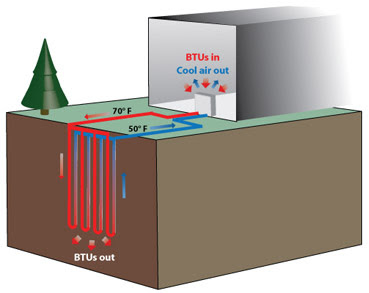
in and out cooling
A loop with a compressor takes heat from the ground and pumps it into the inside heating loop, circulating the natural heat throughout the house. In the summer months, a geothermal heat pump will work in reverse, channeling the warmer air and forcing it into the ground. This prevents the air conditioner from having to work extra hard to cool your home.
Geothermal heat pumps are an extremely energy efficient way to heat and cool your home. They can use up to 50% less energy than traditional heating and cooling systems.
A major benefit to using these energy saving heat systems is that you won't have to worry about what the external air temperature is or the conditions of the weather outside. They do not depend on the air temperature outside, but rather the temperature of the ground. This means that your geothermal air system will work just as efficiently on a mild day as a blustery winter day.
There are two types of geothermal heat pump, water-to-water and water-to-air. A water-to-water heat pump is usually used for heating only and is a replacement for the conventional oil or gas furnace. These pumps work best when the ground temperature averages between 50 and 75 degrees and are suitable for heating water for bathroom and kitchen use.
Water-to-air heat pumps are most often used for both heating and air conditioning. The water acts as a heat sink that takes in the heat from the house. The air is then circulated around the home through the ductwork. In a heating capacity, a water-to-air geothermal heat pump works similarly to the water-to-water geothermal pump.
In order for you to take full advantage of the benefits these energy-efficient heating and cooling systems can offer, you first need to make sure your home is well insulated. By minimizing heat or cooling leakage through unsealed windows or doors, you can ensure your geothermal system can work to its maximum efficiency. The less it needs to run, the more money you save on utility bills.
If you're considering having a geothermal heat pump installed, make sure you consult an experienced heating and cooling company that can properly put in piping that reaches far through the ground. In some of these new heating and cooling systems, the piping needs to reach as far down as the ground water table. Contracting a company that has extensive experience in geothermal heat pump installation will ensure that your system will run properly and at its highest efficiency.
article by Budda Oliver
Differences in Geothermal Systems
There are a wide range of geothermal system on the market today. There are also a lot of different ways in which geothermal heat pumps are used to heat a project. Here are the most common ways they are configured
1) The most common one in this country is using a buffer tank. Basically here with this system, the heat pump's sole duty is to keep the water in the buffer tank to a set temperature. Usually between 30 and 40 degrees. From this the underfloor heating has a "store" on which it can obtain its hot water for heating the house.

china made-buffer tank
The main advantages is that you have a controlled system. The buffer tank is protecting the heat pump by protecting it every time the heat pump comes on. From this , you are protecting the life span of the compressor i:e, it will only come on when the buffer tank is not at the designated temperature and because it has to heat a big volume of water, it will take some time to do this.
The main disadvantages are
1) Fixed COP (Coefficient of Performance). Even on a mild day outside, the buffer tanks water temperature will still be at the same temperature. This is not required because on a mild day, there is less heat loss from the house, so your underfloor heating does not need the same water temperature in its pipes. Essentially you are paying for too much electricity.
2) The cost of putting in 2 cylinders is a disadvantage (Buffer tank & Domestic hot water cylinder).
3) Space required. You need a big utility room to insert all these items. It is pointless putting a heat pump in a garage off the house because you are going to loose some heat in transit. And because single phase heat pumps do not give big outputs, you want to get everything out of it that you possibly can.
By Jack Foley
Geothermal Heat Pump-Geothermal HVAC Unit
Geothermal technology is rapidly replacing inefficient, outdated heating and cooling systems and improving the quality of temperature control while reducing our dependence on fossil fuels. Government agencies have endorsed geothermal heat pump systems as the most energy efficient, environmentally clean, and cost effective systems for heating and cooling homes. They are the future of climate control and the solution to our energy crisis.

The first ground source heat pump was installed in 1948 as an experiment by Professor Carl Nielson. People quickly realized what a promising energy alternative it would be and began improving and producing the equipment. Modern heat pump systems last much longer, require less maintenance, and are four times more efficient than traditional air-source heat pumps. Today there are well over a million geothermal heat pumps installed worldwide and an additional 80,000 units are installed in the USA each year.
Geothermal heat pumps are exceptionally good for the environment and extremely safe. These systems do not have on-site emissions or flammable materials. By eliminating any combustion you do not have to worry about fumes, odors, or carbon monoxide in your home. According to the U.S. Department of Energy, if just 100,000 homes converted to a geothermal heating and cooling system, carbon dioxide emissions could be reduced by 880 million pounds. Currently, atmospheric CO2 is 30% higher than it was 200 years ago and if not reduced can cause serious detrimental global impacts. Geothermal technology offers a wonderful solution to lowering these greenhouse gases.
As an incentive to install these environmentally-friendly units the government is offering a 30% tax credit based on the installed price of a geothermal heat pump unit that meets or exceeds Energy Star requirements. Although these systems are initially more expensive, this credit offers a tremendous discount and homeowners can expect a significant decrease in their energy bills. Customers often report they receive a full payback on their investment in three to five years.
When you consider the durability, comfort, cleanliness, and energy savings it is obvious why the government has endorsed them as the best systems for temperature control!
By Glenn Egg
Geothermal Heat Pump-The benefits
Even in states without great geothermal resources, a geothermal heat pump can still provide space heating and air conditioning. Like a refrigerator or air conditioner, these systems use a heat pump to force the transfer of heat from the ground to the application. In theory, heat can be extracted from any source, no matter how cold, but a warmer source allows higher efficiency. A ground-source heat pump uses the shallow ground (typically at 10-12°C, 50-54°F) as a source of heat, thus taking advantage of its seasonally moderate temperatures. In contrast, an air-source heat pump draws heat from the colder outside air and thus requires more energy.

Geothermal heat pumps are similar to usual heat pumps, but use the ground instead of outside air to provide heating, air conditioning and, in most cases, hot water. Because they use the earth's natural heat, they are among the most efficient and comfortable heating and cooling technologies currently available.
The heat pump system uses solar energy stored in the earths crust. Energy is transferred to and from the earths surface by solar radiation, wind and rainfall. As a consequence of this solar energy, the earths temperature at depths greater than 10 meters remains constant, and is comparable to the annual average air temperature. Between the surface and a depth of 2.5 meters (maximum depth for a horizontal loop) the ground temperature will swing above and below the annual average air temperature , depending on the geographic location, soil type an moisture levels
Benefits
Ground Source Heat Pumps or geothermal Heat pumps offer great benefits:
• Simultaneously heat & cool different parts of the same building
• Very quiet-users do not know when the system is operating
• Can be set up in multiple zones, with each zone having an individual room control
• Greater freedoms in building design due to 50-80% less mechanical room space
• No outside equipment to hide, eliminating vandalism and roof top units
• Pipes have 50-year life expectancy
• all electric, which eliminates multiple utility services
• Expel boiler and chiller maintenance
By Narendra Kumar Singh
Geothermal Heat Pump-Open and closed systems
There are two types of ground source heat pump systems: those with closed loops and those with open loops.Ground source heat pumps also known as geothermal heat pump.

In closed loop systems, liquid (usually with some sort of anti freezing/anti boiling agent mixed in) circulates through pipes buried beneath the earth's surface. During the winter, when the goal is warming a house, the fluid absorbs heat from the earth and carries back to the building. This very hot liquid can be effectively used to heat a home, and also quite obviously becomes a free-flowing source of usable hot water. During the summer, the system is designed to actually draw heat out of the building, and either use it to heat water for household use or deliver it back into the ground.
Open looped systems are quite similar, except that the water supply within the pipes is continually refreshed.
The bulk of geothermal heat pump (Ground source heat pumps) systems are the pipes that are buried far underground, so what is needed in your home is a unit likely no bigger than your current hot water heater and furnace. If you currently use oil, you may be able to get rid of or at least substantially downsize the size of your oil tank.
If you already have a forced air oil or gas-fed furnace system it may be easy for you to convert to what is called a "dual system". In this case you would choose which heating and cooling system would be primary at any particular time - most likely the geothermal system - and the other system will only work when needed, such as during an extremely cold spell in the winter
Ground source heat pumps are quiet and safe. There are no exposed parts, fans, storage tanks, etc. that can hurt kids or pets. Nothing is burned so there is no flame. The heating source is the earth so there is nothing to wear out. They are also quiet because the earth is doing the work of the motors in your current furnace.
The initial cost for ground source heat pumps is greater than that of a conventional oil or gas system. However, that initial cost is often made up in three to six years depending on the cost of fuel and the temperature in your area. The greatest benefit of these systems is that you no longer have to use oil or gas at all.
note:refer videos for more information on systems
Subscribe to:
Posts (Atom)